
Stop reviewing PRs, build the harness
Two years ago I wrote Pull request best practices Pit fall. The short version: tiny PRs and a wall of text in the description don't fix your code reviews. When everyone in the team is busy with their own work, nobody has the context to review 15 small fragments of somebody else's feature. They check the syntax, leave a "nit", and move on.
I re-read it this week. A lot has changed since then. Most of my code is now written by AI agents, and I wanted to see if my take aged well or not.
I think it's more relevant than ever. But the conclusion goes further than I did back then.
What still holds#
My main point was: ship the complete flow, so people can see the whole feature instead of a chain of small pieces. Back then I argued it from the reviewer's side. A full flow forces you to understand the big picture, and you only switch context once.
There was another reason I didn't put enough weight on. A complete feature is something you can actually test end to end. You can open it, click through it, and see if it works. Fifteen small PRs that only make sense together can't give you that.
With agents, this matters even more. An agent can split one flow into 15 tidy PRs in minutes, and each one looks perfectly fine on its own. The bug doesn't live in any single diff. It lives in the flow.
What changed#
Here's the uncomfortable part. Nobody is going to review agent code line by line. Let's be honest, most of us weren't really doing it properly before either. Now the volume is just too high. An agent can produce a day of work in an hour, and if every line still has to go through a human reading the diff, the human becomes the bottleneck and starts skimming. That's the worst of both worlds: slow and not even safe.
So I stopped asking "how do we review these PRs better?" and started asking "what do I actually need to trust this change?"
Build the harness instead#
The harness is the system the agent works inside. If it's good, the agent can't go far wrong, and the PR becomes a formality. This is what mine looks like:
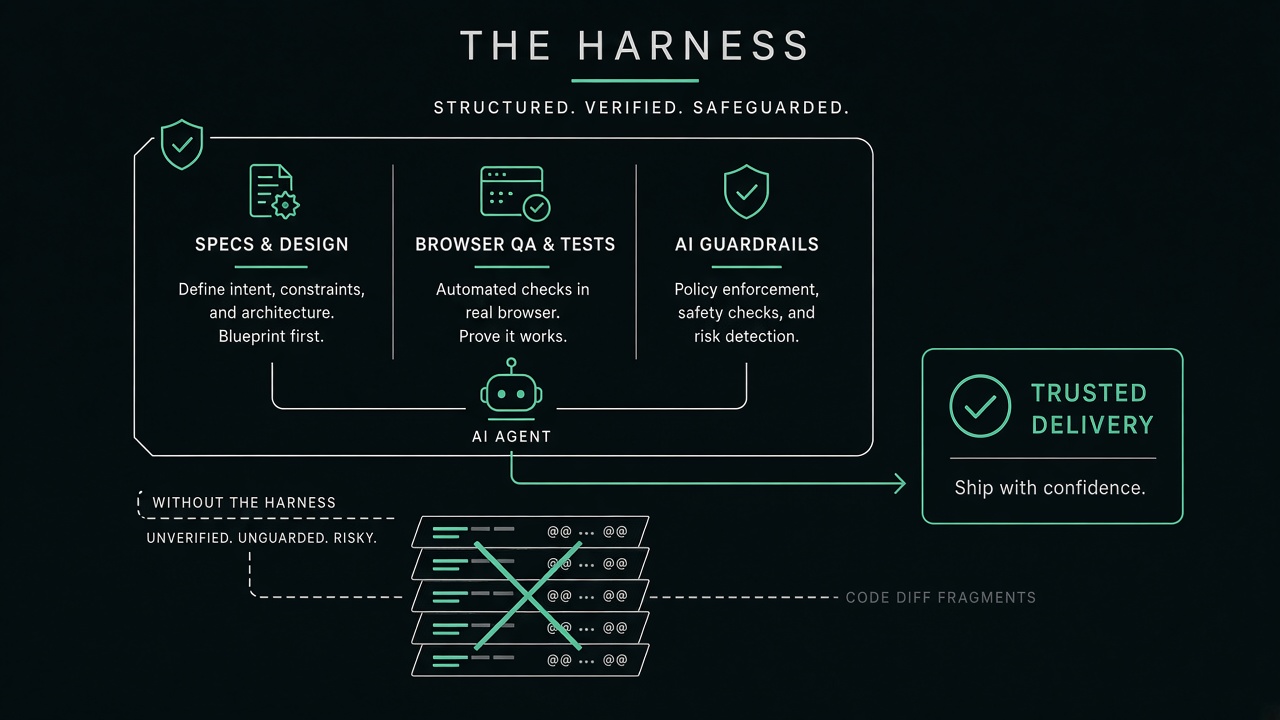
- Specs and design first. Every feature starts with a PRD, then a solution design, then a phase plan that gets checked before any code is written. The decisions go into a decision register, so the agent builds against what we agreed instead of guessing. This is where I spend most of my review energy now: on the plan, not the code.
- Tests and browser QA on every branch. Unit tests, plus an agent that opens the feature in a real browser and walks through the flows, the same way I would. If it doesn't work, it doesn't merge.
- AI review and guardrails. An AI reviewer checks every branch for the nits, the security issues, and drift from the design and the recorded decisions. That's the part busy humans were skimming anyway.
On my last project, this is how a new product went from an empty folder to production in 6 weeks, with no major incidents.
So what's left in the PR?#
Two things:
- An overview of the workflow and the design. What we built, why, and the key decisions. Short. A link to the solution design is usually enough.
- The QA evidence. Test results, browser QA runs, screenshots of the flow working.
That's what a reviewer actually needs to say yes. Not 3,000 lines of code nobody typed by hand.
Where I'd be careful#
This isn't "stop caring about quality". It's moving the care to a better place.
- Review the harness itself. When someone changes the tests, the QA flows or the review rules, that change deserves a proper human review. The harness is now the thing protecting production.
- Someone still owns it. The agent wrote the code, but you shipped it. If it breaks in prod, "the AI did it" isn't an answer.
- Measure it. If bugs start slipping through, the harness has a gap. Find it and fix it, don't go back to reading every diff.
Conclusion#
Two years ago I said best practices like small PRs and long descriptions aren't a fix by themselves, and that a lead should find the real bottleneck instead of repeating well-known advice. Same lesson today. The bottleneck isn't PR size anymore. It's context and trust.
Put your energy into the harness, and let the PR be the delivery box.
What do you reckon? Are you still reviewing diffs, or building the harness?